

IVA sales
What is the sales to registered taxpayers book?
The sales to registered taxpayers book organizes transactions issued to customers who are also registered taxpayers. It usually includes Comprobantes de Crédito Fiscal (CCF), credit notes and debit notes because these documents affect output tax, adjustments and the tracking of taxable sales.
In the DTE environment, the document type is essential. For this workflow, AIBEX treats type 03 as a Comprobante de Crédito Fiscal, 05 as a credit note and 06 as a debit note. A type 01 final-consumer invoice does not belong in the taxpayer sales book.
- Used for sales documented with CCF and related documents.
- Must be kept separate from final-consumer sales.
- Credit and debit notes adjust earlier transactions.
- DTE JSON makes it easier to read control numbers, generation codes and amounts.
Which DTE belong in taxpayer sales?
The most important operational step is to classify by DTE type before filling in the book. A type 01 file belongs in the final-consumer workflow. Types 03, 05 and 06 are normally reviewed under taxpayer sales.
This separation prevents mixed documents and time spent correcting annexes. It also helps identify documents that arrived in the correct inbox but do not belong in the selected book.
| DTE type | Usual name | Expected book |
|---|---|---|
| 03 | Comprobante de Crédito Fiscal (CCF) | Sales to registered taxpayers |
| 05 | Credit note | Sales to registered taxpayers |
| 06 | Debit note | Sales to registered taxpayers |
| 01 | Final-consumer invoice | Final-consumer sales, not taxpayer sales |
Fields worth reviewing
Fields vary by format and annex, but day-to-day review should include the date, document type, control number, generation code, customer name or identification, taxable sales, IVA, exempt amounts and adjustments from notes.
In a DTE, the receipt seal and generation code help trace the document. Some export or annex formats require values without hyphens or with a specific structure. A tool therefore needs to map fields, not simply read visual text.
Common mistakes
The most common mistake is putting final-consumer invoices in taxpayer sales. Another is treating a credit note as a new sale when it actually adjusts a transaction. Working from downloaded PDFs without the original JSON also creates problems.
The correct approach is to filter by DTE type, validate the period, detect duplicates and review totals before exporting. This reduces manual corrections at month-end.
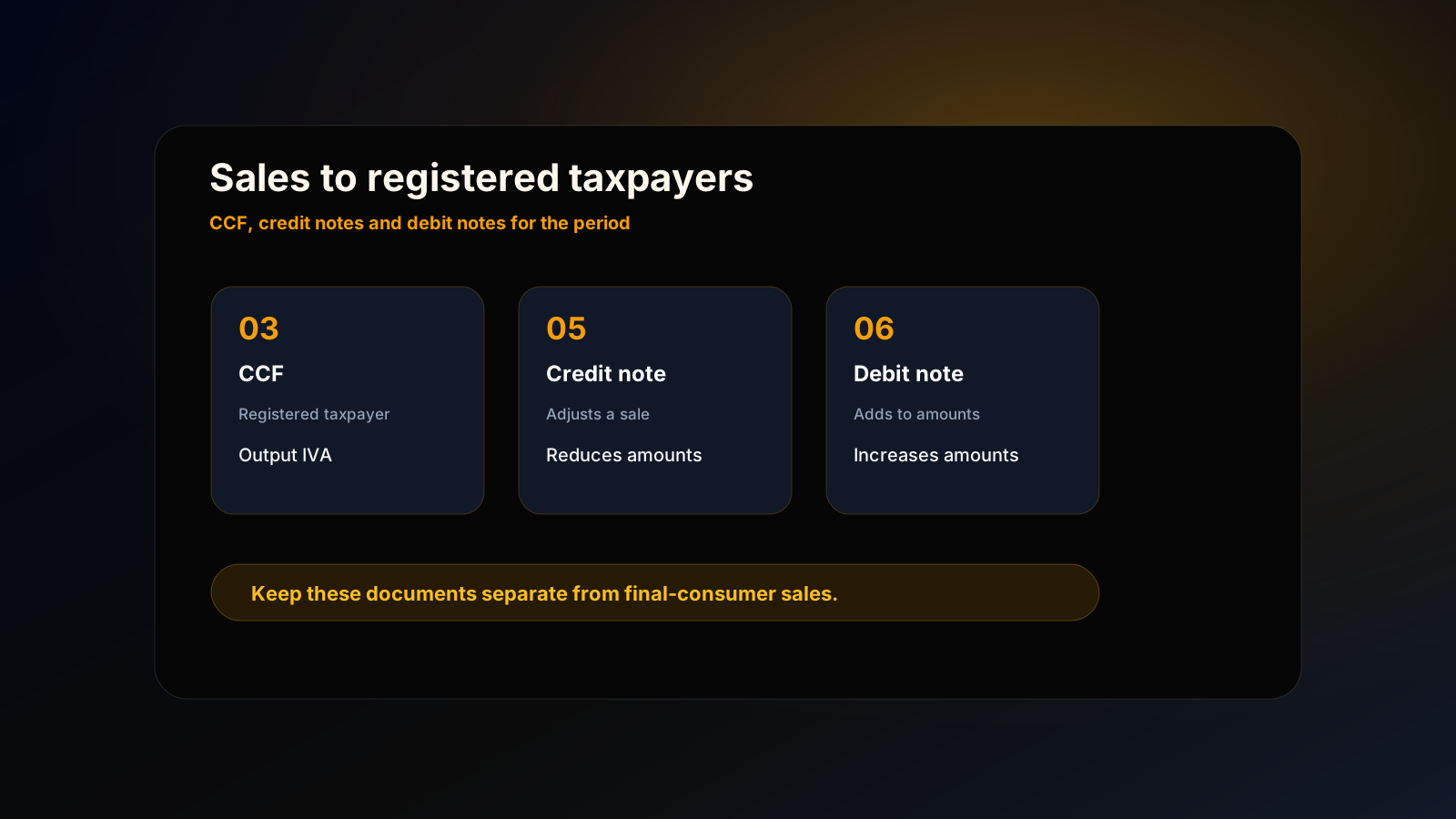
How AIBEX separates CCF, notes and final-consumer invoices
In AIBEX, choose Taxpayer Sales before dropping in the JSON files. The processor rejects documents that do not belong in that book and creates a table you can review.
1. Select Taxpayer Sales
The workflow accepts DTE types 03, 05 and 06, the expected documents for this book.
2. Drop in the period’s JSON files
AIBEX reads the documents, displays rejections for incorrect types and keeps books from being mixed.
3. Review the grid
You retain final control over rows, totals and exports.
Frequently asked questions
Which DTE type is a CCF?
In the AIBEX workflow, a Comprobante de Crédito Fiscal is identified as DTE type 03.
Does a final-consumer invoice belong in taxpayer sales?
No. A type 01 final-consumer invoice belongs in the final-consumer sales book.
Are credit notes recorded in the same way as sales?
Not exactly. They are adjustment documents and must be handled according to their effect on the original transaction.
Sources consulted
This guide is educational and does not replace current regulations. For tax decisions, review your specific situation with the responsible person or a tax adviser.
F-07 Annexes Manual v14
Official tax annex manual used as a reference for the F-07 structure (in Spanish).
Regulations implementing the Tax Code
Official reference for formal obligations and IVA-related records (in Spanish).
El Salvador IVA Law
General legal basis for the tax, input tax credit and output tax (in Spanish).
Official electronic invoicing portal
Public Ministerio de Hacienda portal on DTE and electronic invoicing (in Spanish).
DTE regulations
Official compilation of regulations applicable to electronic tax documents (in Spanish).
DTE technical and functional information
Guides, manuals and technical documents for DTE implementation (in Spanish).
Keep reading
AIBEX Guides
Final-consumer sales
A guide to the final-consumer sales book, which DTE belong in it and how to avoid mixing invoices with CCF.
OpenAIBEX Guides
DTE JSON to IVA books
A practical tutorial on turning DTE JSON into purchases, taxpayer sales, final-consumer sales and IVA withholding books.
OpenAIBEX Guides
DTE and electronic invoicing
Electronic tax documents, JSON, receipt seals and their impact on IVA books for businesses and individuals preparing their tax information.
Open